
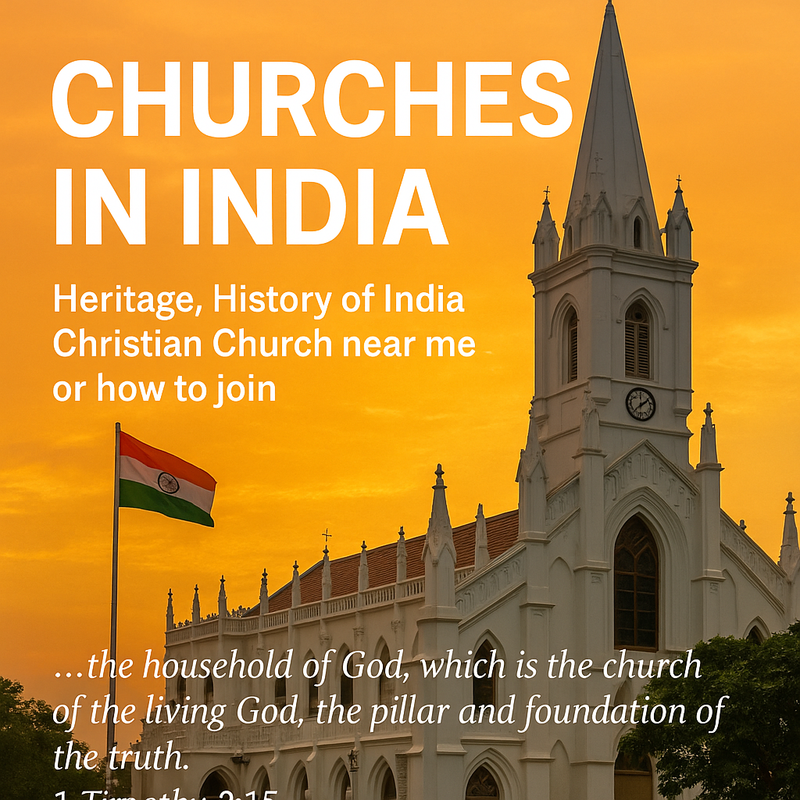
Churches in India – History, Christian Heritage, and How to Join a Church in India
India is a land of deep spiritual searching and profound religious diversity. Yet within its borders, the Christian Church in India continues to stand as a living testimony to the transforming power of the gospel of Jesus Christ. Far from India Churches being a Western import, Christianity in India traces its roots back to the Apostle Thomas, who, according to tradition, arrived on Indian soil around A.D. 52. Since then, the Church in India has grown quietly but powerfully—amid persecution, cultural challenges, and remarkable spiritual hunger.
Today, churches in India reflect a beautiful tapestry of traditions—Protestant, Catholic, Orthodox, Evangelical, and Charismatic. From the ancient St. Thomas churches in Kerala to dynamic worship gatherings in Delhi, from historic cathedrals in Goa to house churches in tribal villages of Northeast India, the body of Christ in India is as diverse as it is devoted.
But what really constitute the Church in India?
“...the household of God, which is the church of the living God, the pillar and foundation of the truth.”
— 1 Timothy 3:15
The true India Church is not just a architectural building. It is a community of true believers, called out by God through faith in Jesus Christ, saved by grace (Ephesians 2:8–9), and united under the headship of our Lord Jesus Christ (Colossians 1:18). Whether you're in Mumbai, Chennai, rural Bihar, or part of the Indian diaspora abroad, God is calling India people into His Church—a worldwide family marked by prayer, fellowship, discipleship, and evangelism.
If you are:
-
Curious about the origin of Christianity in India,
-
Longing to experience biblical community,
-
Or wondering how to find or join a Christ-centered church in India,
this article will guide you with Scripture-based insights, practical steps, and historical context.
📖 Also explore these helpful resources:
-
🙏 The Church in India Needs Your Prayers — learn how to intercede for revival and strength in the Indian Church.
-
🕊️ What Is the Church? Biblical Meaning, Purpose, and How to Join One — understand the true nature of the Church and what it means to belong.
“For where two or three are gathered in my name, there am I among them.”
— Matthew 18:20
📖 Table of Contents
-
A Brief History of Christianity in India and the Church in India
- How to Find a Bible-Based Church in India
-
The Christian Heritage of India: Contributions to Society and Faith
A Brief History of Christianity in India and the Church in India
The presence of Christianity in India is far older than many realize. Often misunderstood as a foreign or colonial religion, Christianity in India actually dates back to the first century A.D., with a rich legacy of faith, sacrifice, and service. Understanding this heritage deepens our appreciation of the vibrant church in India today.
🕊️ Apostolic Foundations: The Arrival of St. Thomas (52 A.D.)
-
According to early church tradition and historical sources, St. Thomas the Apostle, one of Jesus’ twelve disciples, arrived in India in 52 A.D., landing on the Malabar Coast (modern-day Kerala).
-
He is believed to have established seven churches, converted many—including members of high castes—and was eventually martyred in Mylapore, near present-day Chennai.
-
These early Christians became known as the St. Thomas Christians or Mar Thoma Christians, preserving apostolic customs and Eastern liturgy for centuries.
“Their faith is known throughout the world.” – cf. Romans 1:8
🛕 Early Christian Presence and Trade Influence (4th–15th Century)
-
Indian Christians maintained close ties with the Persian and Syrian Churches, particularly the Church of the East.
-
They developed strong ecclesiastical traditions, including the Syro-Malabar and Syro-Malankara rites.
-
Christianity coexisted peacefully with other Indian religions and contributed to local society through medicine, education, and trade.
⚓ Colonial Missions: the Portuguese (1498–1700s)
-
When Vasco da Gama arrived in 1498, Portuguese missionaries began spreading Roman Catholicism, especially along the western coast.
-
St. Francis Xavier, a Jesuit, preached fervently across Goa and Tamil Nadu, leading mass conversions and establishing schools and churches.
-
However, tensions arose between Catholic missionaries and indigenous Christians, especially due to forced Latinization during the Goan Inquisition.
📚 Reformation Influence and Protestant Growth (1700s–1800s)
-
Protestant missions began with the Danish-Halle Mission in Tranquebar (1706).
-
William Carey, a Baptist missionary, arrived in 1793, translating the Bible into multiple Indian languages, establishing the Serampore College, and influencing education and social reforms.
-
Methodists, Lutherans, Presbyterians, and other denominations followed, emphasizing preaching, printing, and planting churches.
🔥 20th Century: Revival, Indigenous Leadership, and House Churches
-
The 1900s saw the rise of:
-
Pentecostal movements, especially in Andhra Pradesh, Kerala, and the North-East.
-
Indigenous churches, such as the Believers Eastern Church, Indian Pentecostal Church, and New Life Fellowship.
-
Thousands of house churches and mission agencies led by Indian Christians, ministering even in remote and hostile areas.
-
-
Despite episodes of persecution and anti-Christian sentiment, the Church has remained resilient, growing through prayer, service, and martyrdom.
“The light shines in the darkness, and the darkness has not overcome it.” – John 1:5
📊 Christianity in India Today
| Statistic | Approximate Value |
|---|---|
| Christian Population | 2.3% (~30 million) |
| Largest Christian States | Kerala, Nagaland, Mizoram, Meghalaya |
| Major Denominations | Syro-Malabar, Syro-Malankara, CSI, Pentecostal, Baptist, Orthodox, Roman Church |
| Official Recognition | Christianity is one of six constitutionally recognized religions in India |
| Key Contributions | Education, Healthcare, Social Services, Orphanages, Women's Empowerment |
How to Find a Bible-Based Church in India
India is home to thousands of churches, but not all of them are rooted in sound biblical teaching. With the rise of false prophets everywhere in the world, prosperity teachings, and cultural distortions of the gospel, it’s important to prayerfully seek a church in India that aligns with the truth of God’s Word.
Here’s a step-by-step guide to help you find a Bible-based Christian church in India:
1. Start with Prayer
Before anything else, pray. Ask the Lord to lead you to a fellowship that glorifies Him and helps you grow in your faith.
“Trust in the Lord with all your heart and lean not on your own understanding; in all your ways submit to Him, and He will make your paths straight.”
— Proverbs 3:5–6
2. Use Trusted Christian Directories
Look up churches through platforms you trust. Some helpful sources include:
- Seventh-day Adventist Church Locator
-
Evangelical Fellowship of India (EFI)
-
Indian Pentecostal Church of God (IPC)
-
Baptist and Reformed networks
-
Local listings through Epifia and mission organizations
Check these churches belief on their websites if available.
3. Check the Church’s Core Beliefs
A Bible-based church will affirm the following:
-
The Trinity – Father, Son, and Holy Spirit
-
Salvation is by grace through faith in Jesus Christ alone (Ephesians 2:8–9)
-
The Bible is God’s inspired Word, the final authority (2 Timothy 3:16)
-
Christ is the only mediator between God and man (1 Timothy 2:5)
Avoid churches that:
-
Glorify the pastor more than Christ
-
Focus solely on wealth and miracles without biblical foundation
-
Discourage Bible reading or questioning
4. Attend and Observe
Visit the church physically or attend online services. Ask yourself:
-
Is the Bible faithfully preached?
-
Is Jesus Christ the center of worship and teaching?
-
Do they show love, hospitality, and belief in God's call to holiness?
-
Is there accountability, prayer, and fellowship?
5. Ask Questions
Don’t be afraid to ask:
-
How do they view Scripture?
-
What do they teach about salvation?
-
Do they offer Bible studies?
-
Are members encouraged to grow in faith and service?
6. Watch for Biblical Practices
A healthy, Bible-based church will usually include:
-
Regular preaching of God’s Word
-
Prayer gatherings
-
Baptism and the Lord’s Supper
-
Fellowship and support
-
Evangelism and missions
“They devoted themselves to the apostles’ teaching and to fellowship, to the breaking of bread and to prayer.”
— Acts 2:42
7. Seek Counsel from Mature Believers
Ask mature Christians you trust to recommend churches. Online forums or communities such as Epifia may also help you connect with believers in your area in India.
8. Be Willing to Commit
Once you’ve found a sound local church, commit to it. Join their fellowship, submit to their leadership, and serve with your gifts.
“Let us not give up meeting together, as some are in the habit of doing, but encouraging one another…”
— Hebrews 10:25
Top Christ-Centered Church Denominations in India
India is home to a vibrant mosaic of Christian traditions. While Christianity is a minority faith in the country, it has deep roots and continues to grow—especially in South India, the Northeast, and among tribal communities. Amid the diversity, certain denominations have remained Christ-centered, Scripture-based, and mission-minded.
Below are some of the top church denominations in India known for proclaiming the gospel of Jesus Christ faithfully and equipping believers for spiritual growth:
Seventh-day Adventist Church in India
Bible-Based. Sabbath-Keeping. Christ-Centered.
The Seventh-day Adventist Church (SDA) in India stands as a strong voice for biblical truth, holistic living, and the soon return of Jesus Christ. With roots dating back to the early 20th century in India, the SDA Church has grown into a nationwide movement, known for its emphasis on:
-
Biblical Teaching
-
Sabbath Worship (Saturday)
-
Health and Wellness Ministry
-
Christ-centered Education
-
Prophetic Truth and the Second Coming of Jesus
What Makes SDA Churches Unique?
-
Biblical Authority – Every belief is grounded in Scripture (2 Timothy 3:16).
-
Sabbath Observance – Worship takes place on the seventh day, Saturday (Exodus 20:8–11).
-
Health Message – Promoting vegetarian lifestyle, disease prevention, and health education.
-
Advent Hope – Preaching the soon return of Jesus Christ (Titus 2:13).
-
Mission-Focused – Active in education, medical outreach, and rural evangelism.
10 SDA Church Locations in India You Can Visit
Whether you're looking for a local congregation, a place to worship during travel, or seeking to join a Christ-centered church, here are ten active Seventh-day Adventist churches and mission centers across India:
-
Spicer Adventist University Church
Spicer Adventist University Campus
Aundh Road, Pune – 411067, Maharashtra -
Lowry Memorial SDA Church
Door No. 23/2, KR Puram, Old Madras Road
Bangalore – 560016, Karnataka -
Nuzvid Seventh-day Adventist Church
SDA Campus, Nuzvid – 521201
Eluru District, Andhra Pradesh -
Shillong Seventh-day Adventist Church
Near Civil Hospital, Laitumkhrah
Shillong – 793003, Meghalaya -
Delhi SDA Church
SDA Church Complex, 47-E, Raj Niwas Marg
Civil Lines, Delhi – 110054 -
Surat Seventh-day Adventist Church
SDA Church Campus, Ghod Dod Road
Surat – 395001, Gujarat -
Kottayam SDA Church
Opposite Collectorate, Kodimatha
Kottayam – 686013, Kerala -
Ranchi Seventh-day Adventist Church
Booty More, Near CCL Guest House
Ranchi – 834009, Jharkhand -
Chennai Central SDA Church
78, Poonamallee High Road
Kilpauk, Chennai – 600010, Tamil Nadu -
Mizoram SDA Church (Aizawl)
Mission Vengthlang, Near Sikulpuikawn
Aizawl – 796005, Mizoram
Looking for an SDA Church Near You?
Visit the official Seventh-day Adventist India Union directory or contact a local pastor through the Southern Asia Division for more churches, schools, and health centers across India.
“Here is the patience of the saints: here are they that keep the commandments of God, and the faith of Jesus.”
— Revelation 14:12
The Seventh-day Adventist Church in India invites all who seek truth, healing, and spiritual revival through Jesus Christ.
Church of South India (CSI)
United in Christ. Rooted in Scripture. Committed to Service.
The Church of South India (CSI) is one of the largest and most historic Protestant denominations in India. Formed in 1947, the CSI was born out of a visionary union of multiple Protestant traditions—Anglican, Methodist, Presbyterian, Congregational, and Reformed churches—making it a remarkable example of Christian unity.
CSI continues to stand for:
-
Unity in Christ across denominational lines
-
Biblical preaching and sacraments
-
Service to the poor and marginalized
-
Education and social development
-
Evangelism rooted in love and humility
What Makes the CSI Church Unique?
-
Ecumenical Spirit – One of the world’s earliest and largest successful church unions.
-
Scripture-Based Worship – Weekly services rooted in the Bible and liturgical traditions.
-
Cultural Adaptation – Worship in local languages and contextual mission.
-
Social Action – CSI runs hundreds of schools, hospitals, and NGOs.
-
Strong Rural and Urban Presence – Especially throughout Southern India.
10 CSI Churches You Can Visit in India
These are active CSI congregations across South India where people gather to worship Jesus, serve their communities, and grow in faith:
-
St. George’s Cathedral, Chennai
222 Cathedral Road, Gopalapuram
Chennai – 600086, Tamil Nadu -
CSI Wesley Church, Secunderabad
Sardar Patel Road, Near Clock Tower
Secunderabad – 500003, Telangana -
CSI Holy Trinity Cathedral, Bangalore
Trinity Circle, MG Road
Bangalore – 560001, Karnataka -
CSI Christ Church, Trivandrum
Palayam Junction, Near Secretariat
Thiruvananthapuram – 695001, Kerala -
CSI Cathedral Church, Madurai
89–91 East Veli Street
Madurai – 625001, Tamil Nadu -
CSI All Saints Church, Hyderabad
Trimulgherry, Near Mehdipatnam
Hyderabad – 500015, Telangana -
CSI St. Paul’s Church, Vellore
Officers Line, Near Old Bus Stand
Vellore – 632001, Tamil Nadu -
CSI Immanuel Church, Ernakulam
Near Maharaja's College
Ernakulam – 682011, Kerala -
CSI St. Luke’s Church, Mysore
2nd Cross, Chamundipuram
Mysuru – 570004, Karnataka -
CSI Church of Hope, Tirunelveli
Palayamkottai Road
Tirunelveli – 627002, Tamil Nadu
How to Find a CSI Church Near You
You can locate nearby CSI churches and institutions by visiting the official Church of South India website at csisynod.com, or by searching “CSI Church near me” on Google Maps with your city name.
“There is one body and one Spirit... one Lord, one faith, one baptism.”
— Ephesians 4:4–5
The Church of South India invites all—young or old, rich or poor—to discover new life in Jesus through worship, community, and service.
Church of North India (CNI)
United for the Gospel. Rooted in Justice. Serving with Love.
The Church of North India (CNI) was formed in 1970 as a powerful expression of Christian unity among different Protestant denominations in the northern and central regions of India. Like its southern counterpart, CSI, the CNI brings together Anglican, Methodist, Presbyterian, Baptist, and other Reformed traditions into a single church body.
What the Church of North India Stands For
-
Faithful Worship and Bible Teaching
-
Gospel-centered Education and Healthcare
-
Evangelism among rural and tribal communities
-
Justice, peace, and care for the oppressed
-
Unity in Christ across denominational lines
The CNI is a living witness to the love of Jesus in both urban cathedrals and remote mission stations. It operates schools, hospitals, and service projects while remaining deeply committed to Scripture and the historic Christian faith.
10 CNI Churches You Can Visit in India
These are active congregations where the message of Jesus Christ is proclaimed, and believers gather for worship, prayer, and service:
-
St. James' Church, Delhi
Church Road, Kashmere Gate
Delhi – 110006 -
St. Paul’s Cathedral, Kolkata
Cathedral Road, Maidan
Kolkata – 700071, West Bengal -
All Saints Cathedral, Allahabad (Prayagraj)
M.G. Marg, Civil Lines
Prayagraj – 211001, Uttar Pradesh -
St. Stephen's Church, Jabalpur
Near Christ Church School
Jabalpur – 482002, Madhya Pradesh -
Holy Trinity Church, Patna
Near Gandhi Maidan
Patna – 800001, Bihar -
Christ Church Cathedral, Lucknow
Hazratganj, Near General Post Office
Lucknow – 226001, Uttar Pradesh -
St. Thomas Church, Ranchi
Church Road, Main Road
Ranchi – 834001, Jharkhand -
St. Andrew’s Church, Bhopal
Jehangirabad, Opp. Old Secretariat
Bhopal – 462003, Madhya Pradesh -
St. Peter’s Church, Jaipur
Mission Compound, Near MI Road
Jaipur – 302001, Rajasthan -
St. John’s Church, Amritsar
Near District Court, Mall Road
Amritsar – 143001, Punjab
How to Connect with a CNI Church
You can explore more about CNI and find churches through the official Church of North India Synod website at cnisynod.org, or search for “CNI church near me” using your city name.
“He has shown you, O man, what is good; and what does the Lord require of you but to do justice, and to love mercy, and to walk humbly with your God?”
— Micah 6:8
The Church of North India continues to bring hope, healing, and truth through Christ in both cities and rural villages alike.
Malankara Orthodox Syrian Church
Ancient Roots. Apostolic Faith. Living Tradition.
The Malankara Orthodox Syrian Church, also known as the Indian Orthodox Church, traces its origins to St. Thomas the Apostle, who is believed to have preached the gospel in Kerala around A.D. 52. This makes it one of the oldest Christian communities in the world—and uniquely Indian in identity.
As part of the Oriental Orthodox tradition, the church maintains the Nicene Creed, apostolic succession, and rich liturgical worship. It combines deep spiritual heritage with a firm commitment to biblical values, community care, and the teachings of the early Church Fathers.
What the Malankara Orthodox Church Stands For
-
Apostolic faith passed down since the time of the apostles
-
Liturgical worship rooted in Scripture and early Christian tradition
-
Community life focused on love, service, and spiritual formation
-
Orthodox doctrine grounded in the early Ecumenical Councils
-
Unity with the global Oriental Orthodox communion
10 Malankara Orthodox Churches You Can Visit in India
These churches represent active worship communities across South India where you can experience the beauty of Orthodox faith and fellowship:
-
St. Mary’s Orthodox Cathedral, Pazhanji
Pazhanji P.O., Thrissur District
Kerala – 680542 -
Mar Elia Cathedral, Kottayam
Catholicate Palace Road
Kottayam – 686001, Kerala -
St. George Orthodox Church, Puthuppally
Puthuppally P.O., Near Kottayam
Kerala – 686011 -
St. Thomas Orthodox Cathedral, Chennai
3rd Street, West Mambalam
Chennai – 600033, Tamil Nadu -
St. Mary’s Orthodox Church, Coimbatore
Trichy Road, Ramanathapuram
Coimbatore – 641045, Tamil Nadu -
St. Gregorios Orthodox Church, Bangalore
TC Palya Main Road, Ramamurthy Nagar
Bangalore – 560016, Karnataka -
St. Mary’s Orthodox Church, Pune
Near Golf Club, Airport Road
Pune – 411006, Maharashtra -
St. George Orthodox Church, Delhi
Mayur Vihar Phase-1, Pocket III
New Delhi – 110091 -
St. Thomas Orthodox Cathedral, Dubai (For diaspora reference)
Near Al Qusais Police Station
Dubai, UAE -
Mar Gregorios Orthodox Church, Mumbai
Sion Trombay Road, Chembur
Mumbai – 400071, Maharashtra
How to Connect
You can explore more about the Malankara Orthodox Syrian Church by visiting the official website:
https://mosc.in
Or search “Malankara Orthodox Church near me” in your city or state.
“Hold fast the pattern of sound words which you have heard from me, in faith and love which are in Christ Jesus.”
— 2 Timothy 1:13
The Malankara Orthodox Church continues to serve India with a Christ-centered witness that is both ancient and relevant for today.
Evangelical Fellowship of India (EFI)
United in the Gospel. Faithful to the Word. Impacting the Nation.
The Evangelical Fellowship of India (EFI) is not a single denomination, but a vibrant national alliance of evangelical churches, organizations, and missions united by their shared commitment to the gospel of Jesus Christ. Since its founding in 1951, EFI has served as a spiritual backbone for evangelical believers across India—promoting unity in doctrine, integrity in leadership, and boldness in evangelism.
EFI is affiliated with the World Evangelical Alliance (WEA) and represents thousands of churches and Christian ministries working in various regions, languages, and cultural contexts throughout India.
What EFI Stands For
-
Biblical Authority – Committed to the inerrancy and sufficiency of Scripture
-
Evangelism & Church Planting – Equipping churches to proclaim Christ faithfully
-
Unity in Diversity – Bringing together various evangelical traditions under one spiritual umbrella
-
Discipleship & Mission – Strengthening believers to follow Christ and make Him known
-
Advocacy for Religious Freedom – Supporting the rights of Christians across India
Where You Can Connect with EFI Member Churches
While EFI itself is not a local church, it partners with thousands of evangelical congregations across India. Here are 10 cities where you can find EFI-affiliated churches or networks:
-
Delhi – Evangelical churches and house fellowships across the NCR region
-
Mumbai – Gospel-centered churches working among youth and professionals
-
Chennai – Strong network of Tamil evangelical churches and mission schools
-
Hyderabad – Evangelical Bible-believing churches involved in urban outreach
-
Kolkata – Churches engaged in slum ministries and discipleship programs
-
Bengaluru – Vibrant mix of student, family, and migrant fellowships
-
Ranchi – Tribal and rural evangelical churches active in evangelism
-
Guwahati – Northeastern evangelical churches reaching remote villages
-
Bhopal – Churches with strong roots in prayer and teaching ministries
-
Imphal – Manipur-based fellowships focusing on youth and leadership training
To find a member church near you, visit the official EFI website:
https://efionline.org
A Movement, Not a Monument
EFI empowers the Indian Church to remain faithful to Christ in the face of persecution, societal change, and spiritual need. It believes that the local church is God’s instrument for transforming lives and bringing the gospel to every tribe and tongue.
“Go therefore and make disciples of all nations…”
— Matthew 28:19
Baptist Churches in India
Rooted in Scripture. Committed to Missions. Governed by the Congregation.
Baptist Churches in India are part of a global tradition that emphasizes personal faith in Jesus Christ, believer’s baptism (by immersion), and the authority of the Bible as the final rule of faith and practice. Though diverse in expression and affiliation, Baptist congregations across India are united by a shared focus on biblical preaching, evangelism, and congregational autonomy.
Historical Roots
Baptist missions began in India in the early 19th century through the influence of pioneers like William Carey, who helped translate the Bible into several Indian languages. Over time, local Baptist unions and conventions were formed, reflecting India’s cultural and linguistic diversity.
Key Beliefs and Practices
-
Believer’s Baptism – Baptism is reserved for those who have personally trusted Christ
-
Scriptural Authority – The Bible is God’s Word and the foundation of all doctrine
-
Local Church Autonomy – Each congregation governs itself under the lordship of Christ
-
Evangelism & Discipleship – Every member is called to share the gospel and grow in grace
-
Congregational Leadership – Led by pastors and elders, guided by the Spirit and the Word
Areas Where Baptist Churches Thrive in India
You can find strong Baptist communities and networks in the following regions:
-
Nagaland – Over 75% of the population is Baptist, with many vibrant mission-oriented churches
-
Mizoram – Home to numerous Baptist fellowships involved in Bible education and social work
-
West Bengal – Historic Baptist presence in Kolkata and surrounding areas from missionary roots
-
Andhra Pradesh – Telugu-speaking Baptist churches engaged in rural and urban ministry
-
Manipur – Active among tribal populations with youth and discipleship ministries
-
Assam – Especially in the tea garden communities and tribal belts
-
Jharkhand – Tribal Baptist churches with deep community engagement
-
Odisha – Gospel-centered churches with a strong emphasis on local outreach
-
Chhattisgarh – Rural Baptist missions among unreached people groups
-
Delhi & Urban Centers – English-speaking and Hindi congregations reaching professionals and migrants
Leading Baptist Organizations in India
-
Nagaland Baptist Church Council (NBCC)
-
Baptist Church of Mizoram (BCM)
-
Bengal Baptist Fellowship
-
All India Baptist Fellowship (AIBF)
-
Orissa Baptist Evangelistic Crusade (OBEC)
Each union reflects the local language and culture while staying rooted in core gospel truths.
“Repent and be baptized, every one of you, in the name of Jesus Christ…”
— Acts 2:38
Baptist churches in India continue to grow, especially among youth and tribal populations, offering Bible-based teaching, strong discipleship, and Christ-centered fellowship for seekers and believers alike.
Reformed and Presbyterian Churches in India
Christ-Centered. Scripture-Grounded. Doctrinally Faithful.
Though smaller in number, Reformed and Presbyterian Churches in India are experiencing a steady rise—especially among urban, educated, and doctrinally-minded believers seeking solid biblical teaching and deep theological roots.
Rooted in the Protestant Reformation, these churches emphasize the sovereignty of God, salvation by grace alone through faith, and Scripture as the final authority. They often follow the Westminster Confession of Faith or other historic Reformed catechisms and are marked by expository preaching, covenant theology, and Christ-centered worship.
Core Beliefs and Distinctives
-
Sola Scriptura (Scripture Alone): The Bible is the highest authority in matters of faith
-
Sola Gratia & Sola Fide (Grace Alone, Faith Alone): Salvation is entirely the work of God
-
Christ-Centered Worship: Reverent, Word-based worship focused on the gospel
-
Covenant Theology: A unified redemptive story from Genesis to Revelation
-
Eldership & Church Discipline: Spiritual oversight and pastoral accountability
Where They Are Found
Reformed and Presbyterian congregations are most commonly found in:
-
Bangalore – Home to churches like Reformed Baptist Fellowship and urban Bible-teaching churches
-
Mumbai – Growing fellowships with a strong emphasis on expository preaching
-
Hyderabad – Emerging house churches influenced by Reformed thought
-
Delhi NCR – International congregations and seminaries with Reformed theology
-
Chennai – Reformed theological hubs and training centers
-
Kolkata – Older Presbyterian roots and urban outreach ministries
-
Pune – Reformed church plants serving English-speaking professionals
-
Online Communities – Teaching ministries, podcasts, and theological courses
-
Seminaries – Like Presbyterian Theological Seminary (PTS) in Dehradun
-
International Student Ministries – Reformed influence among Indian students abroad
Representative Churches and Movements
-
Presbyterian Free Church of Central India
-
Reformed Presbyterian Church of India
-
United Church of North India (Reformed stream)
-
Reformed Baptist Churches (independent fellowships)
-
Grace Reformed Churches in Bangalore and Chennai
-
International Presbyterian Church in India
“For it is by grace you have been saved, through faith—and this is not from yourselves, it is the gift of God.”
— Ephesians 2:8 (NIV)
These churches, though relatively few, are deeply committed to building up the Body of Christ through biblical literacy, doctrinal clarity, and discipleship that glorifies God. If you're seeking a church where Scripture is taught faithfully and Jesus is exalted as King and Savior, a Reformed or Presbyterian fellowship may be right for you.
Methodist Church in India
Rooted in Scripture. Alive in Service. Centered in Christ.
The Methodist Church in India (MCI) is part of the worldwide Methodist movement that began in the 18th century under John Wesley. It officially became autonomous in 1981 but traces its Indian roots back to 1817, when Methodist missionaries arrived in Kolkata.
Today, the Methodist Church in India stands as a Christ-exalting and service-driven denomination that blends evangelical preaching with social action. It emphasizes personal holiness, community service, and the transformative power of grace through faith in Jesus Christ.
Core Beliefs and Emphases
-
Justification by Faith – Salvation through Jesus Christ alone (Romans 5:1)
-
Sanctification – Ongoing growth in grace and holiness by the Holy Spirit (1 Thessalonians 4:3)
-
Scripture Authority – The Bible as the guide for faith and practice (2 Timothy 3:16–17)
-
Active Faith – Loving service as a natural outflow of a redeemed heart (James 2:17)
-
Connectionalism – Churches united in mission, doctrine, and accountability
Where You’ll Find Methodist Churches in India
The Methodist Church in India is widespread and organized into regional conferences. Below are major areas of presence and local churches:
| City/State | Church/Address |
|---|---|
| Delhi (North India) | Central Methodist Church, Parliament Street, New Delhi |
| Mumbai (Maharashtra) | Wesley Church, Byculla, Mumbai |
| Chennai (Tamil Nadu) | Methodist Tamil Church, Royapettah, Chennai |
| Hyderabad (Telangana) | Methodist Church, Chapel Road, Abids, Hyderabad |
| Kolkata (West Bengal) | Calcutta Central Methodist Church, Lenin Sarani, Kolkata |
| Bangalore (Karnataka) | Methodist Church, Shivajinagar, Bangalore |
| Lucknow (Uttar Pradesh) | Methodist Church, Hazratganj, Lucknow |
| Pune (Maharashtra) | Methodist Church, Camp Area, Pune |
| Nagpur (Maharashtra) | Methodist Church, Civil Lines, Nagpur |
| Bareilly (Uttar Pradesh) | Bareilly Regional Conference Office, Methodist Mission Compound, Bareilly |
Ministries and Mission
The Methodist Church in India is known for:
-
Education: Schools and colleges like Methodist High School (Kanpur)
-
Healthcare: Hospitals and clinics in underserved regions
-
Women and Youth Ministries: Equipping new generations in Christ
-
Social Justice: Outreach to the poor, Dalits, and marginalized groups
-
Evangelism and Church Planting: Especially in Northern and Central India
“He has shown you, O man, what is good. And what does the Lord require of you?
To act justly and to love mercy and to walk humbly with your God.”
— Micah 6:8
The Methodist Church in India remains committed to living out the gospel of Jesus Christ in both word and deed. If you’re looking for a Bible-believing, mission-minded, and grace-filled church in India, the Methodist Church may offer just the spiritual home you're seeking.
The Christian Heritage of India: Contributions to Society and Faith
India’s Christian heritage is not simply a relic of the past—it is a living legacy of faith, compassion, and transformation. As the Church in India continues to grow, it carries forward a sacred responsibility: to honor Christ by serving others, defending truth, and proclaiming the gospel in every tongue and tribe.
From the earliest believers in Kerala to the many denominations and fellowships that thrive today, Christians in India have made profound contributions—not only to spiritual life, but also to education, healthcare, social justice, and national development.
1. Faithful Witness Across Centuries
-
St. Thomas Christians (also called Mar Thoma or Syrian Christians) have preserved an ancient expression of apostolic Christianity.
-
Evangelists, pastors, and missionaries have served faithfully despite persecution, poverty, or cultural pressure.
-
Today, the Church in India includes millions of believers from every region, language, and tribe—testifying to the power of the gospel across boundaries.
2. Education for All
The Christian Church was instrumental in introducing modern education to India:
-
Mission schools and colleges like St. Stephen’s (Delhi), Madras Christian College (Chennai), and Serampore College (West Bengal) helped raise literacy and learning across castes and communities.
-
Christians pioneered education for girls, lower castes, and rural populations—often decades before government reforms.
-
Many of India’s best-known schools and universities trace their roots to Christian missions.
3. Compassionate Healthcare
Christians have led the way in medical missions, establishing:
-
Hospitals, clinics, and leprosy homes in underserved areas.
-
Institutions like Christian Medical College (CMC), Vellore and CMC Ludhiana, which train thousands of doctors and nurses with a Christ-centered ethic.
-
Mobile medical outreach, maternity homes, and rural health programs serving people of all faiths.
4. Social Reform and Upliftment
Indian Christians have long stood for justice, equality, and human dignity:
-
Missionaries and reformers like William Carey and Amy Carmichael campaigned against sati, female infanticide, and child marriage.
-
Christian organizations continue to work among Dalits, tribals, and marginalized communities, empowering them through education, vocational training, and advocacy.
-
The Church has promoted peacebuilding, anti-human trafficking efforts, and disaster relief across regions.
5. Spiritual Renewal and Evangelism
Above all, India’s Christian heritage is rooted in spiritual transformation:
-
Countless lives have been changed by encounters with Jesus Christ through preaching, personal testimony, and acts of love.
-
India has produced missionaries, theologians, hymn writers, and pastors who now serve the global Church.
-
Revival movements, prayer fellowships, and church plants continue to spread the gospel from village homes to urban centers.
“Let your light shine before others, that they may see your good deeds and glorify your Father in heaven.”
— Matthew 5:16
What to Expect When Attending a Church in India
Attending a church service in India can be a unique and spiritually uplifting experience. Whether you're stepping into a small rural fellowship or a large urban cathedral, churches in India reflect a blend of biblical faith, cultural expression, and communal worship. Attending a church in India is more than just a Sabbath routine—it’s an invitation into the family of God, to walk with fellow believers and grow in Christ together.
Here’s what you can generally expect:
1. Warm Hospitality
-
Most churches in India welcome visitors with kindness and humility, often greeting newcomers personally.
-
Don’t be surprised if someone invites you for tea or a meal afterward—fellowship is an important part of church life.
-
It’s common to remove your shoes before entering some rural or traditional church buildings (though not all).
2. Multilingual Worship
-
Depending on the region, services may be in English, Hindi, Tamil, Telugu, Malayalam, or other local languages.
-
Some churches offer simultaneous translation or separate services in multiple languages.
-
Hymns and songs may be sung in both Western and Indian styles, using instruments like guitars, keyboards, tablas, or drums.
3. Bible-Based Preaching
-
A central focus of most services is the preaching of God’s Word.
-
Expect a message that draws from Scripture, challenges the heart, and encourages Christ-centered living.
-
Many pastors preach in a simple, clear, and passionate manner, often incorporating local illustrations or testimonies.
4. Prayer and Testimony
-
Indian churches are often rich in corporate prayer, with believers praying aloud together or responding to prayer calls.
-
Testimonies—brief accounts of what God has done in someone’s life—are sometimes shared during services, stirring faith and encouragement.
-
Healing prayers and altar calls may be part of the service in charismatic or Pentecostal congregations.
5. Cultural Expressions of Worship
-
Worship is heartfelt and expressive—some raise hands, clap, kneel, or even dance before the Lord.
-
Modesty in dress is appreciated; traditional attire is welcome, but neat Western wear is also common.
-
Certain festivals like Christmas, Easter, and Harvest Sunday are celebrated with joy, color, and community feasts.
6. Holy Communion and Baptism
-
Many churches observe the Lord’s Supper (Holy Communion) monthly or weekly. It’s a solemn and sacred part of the service.
-
Baptisms are often conducted in rivers, baptismal tanks, or pools, following a person’s public declaration of faith in Christ.
7. Opportunities to Grow and Serve
-
Sunday School, youth groups, Bible studies, and mid-week prayer meetings are usually available.
-
Churches often provide ways for believers to volunteer, serve the poor, or join evangelistic efforts in local communities.
-
Some churches may invite you to join discipleship programs or home fellowships.
“For where two or three are gathered in my name, there am I among them.”
— Matthew 18:20
Twelve (12) Common Questions About Indian Churches (FAQ)
Whether you're a seeker, visitor, or returning believer, the church in India welcomes you with open arms. However, understanding the cultural and legal context of Christianity in India is important. Below are some common questions answered with biblical truth, practical insight, and sensitivity to the current environment.
1. Is it safe to be a Christian in India?
Christianity is legally permitted in India, and millions freely practice their faith. However, in some parts of the country—especially in rural or tribal areas—Christians can face hostility, discrimination, or even violence.
-
Radical groups have, at times, attacked churches, disrupted worship, and threatened converts.
-
Pastors and believers have been harassed or arrested under false accusations of forced conversions.
-
Christian schools, hospitals, and charities sometimes face pressure or restrictions despite their social service.
Yet, amid these challenges, the Indian church remains faithful, resilient, and growing. Jesus said:
“In this world you will have tribulation. But take heart; I have overcome the world.” – John 16:33
2. What are anti-conversion laws, and do they affect churches?
Several Indian states (like Uttar Pradesh, Madhya Pradesh, Chhattisgarh, and Odisha) have enacted anti-conversion laws, officially called “Freedom of Religion Acts.”
These laws:
-
Require anyone changing their religion to notify the government.
-
Are meant to prevent coerced or fraudulent conversions, but
-
Are often misused to target peaceful Christian ministry and intimidate new believers.
While these laws do not ban conversion outright, they have created an atmosphere of fear. Still, faith in Christ is a personal decision, and no law can silence the gospel of God’s grace.
3. Have Christians been arrested for their faith?
Unfortunately, yes. Some pastors and lay Christians have been:
-
Arrested during prayer meetings
-
Accused of “allurement” or “forced conversion” simply for sharing their testimony
-
Detained without trial or denied bail for weeks or months
However, many legal advocates and Christian organizations, like the Evangelical Fellowship of India (EFI) and Alliance Defending Freedom (ADF India), work to defend believers and offer legal support.
Jesus reminded His followers:
“Blessed are those who are persecuted for righteousness’ sake, for theirs is the kingdom of heaven.” – Matthew 5:10
4. How can I support persecuted Christians in India?
You can:
-
Pray earnestly for those suffering for Christ
-
Partner with mission organizations serving in high-risk areas
-
Encourage local pastors, missionaries, and house churches
-
Raise awareness and speak up for religious freedom
As Hebrews 13:3 urges us:
“Remember those who are in prison, as though in prison with them.”
5. Can I still attend a church safely?
Yes. Most urban churches and larger congregations operate freely and peacefully. They are open to the public, hold weekly worship services, and engage in community service.
However, discretion is advised when:
-
Visiting rural areas with anti-Christian sentiment
-
Engaging in public evangelism
-
Sharing personal testimony where there is tension
Jesus calls us to be wise as serpents and harmless as doves (Matthew 10:16).
6. Is it illegal to become a Christian in India?
No. India’s Constitution guarantees religious freedom (Article 25), including the right to change your religion. But due to misinformation and social hostility, those who convert—especially from Hinduism—may face:
-
Family rejection
-
Social ostracism
-
Legal pressure under anti-conversion laws
Still, millions have found joy, peace, and eternal hope in Christ, even at great personal cost (Philippians 3:8).
7. Why do Indian Christians continue in the faith despite opposition?
Because Jesus is worth it.
“We are hard pressed on every side, yet not crushed; perplexed, but not in despair… struck down, but not destroyed.” – 2 Corinthians 4:8–9
Indian Christians continue in faith:
-
Because the gospel is the power of God unto salvation
-
Because Christ’s love compels them (2 Corinthians 5:14)
-
Because they have found a living hope (1 Peter 1:3)
8. Can I attend a church even if I’m not a Christian?
Absolutely. Most churches welcome seekers, visitors, and those exploring Christianity. You don’t need to be baptized to attend a service. Churches are places where people hear about Jesus, ask questions, and discover faith.
9. What should I wear to church in India?
Modesty is key. Men often wear trousers and a collared shirt, while women may wear salwar kameez, sarees, or modest Western clothes. There’s no strict dress code, but showing respect through decent attire is appreciated.
10. Is worship in English or local languages?
It depends on the location. Urban churches often offer services in English or bilingually, while rural churches may conduct worship in regional languages. Some churches offer multiple services for different language groups.
11. How do I know if a church is Bible-based?
Look for a church that:
-
Regularly teaches and preaches from the Bible
-
Believes in Jesus Christ as the only way to salvation
-
Encourages prayer, community, and holy living
-
Practices baptism and the Lord’s Supper according to Scripture
You can also explore more guidance in this article on what makes a biblical church.
12. Can I be baptized in India?
Yes. If you decide to follow Jesus and understand the meaning of baptism, churches across India offer baptism classes and public baptisms. Baptism is a joyful declaration of your new life in Christ (Romans 6:4).
Encouragement for India New Believers and Returning Christians
Whether you are new to the Christian faith or finding your way back after years away, God’s arms are wide open. The journey of faith in India today may come with questions, doubts, or even difficulties—but you are not alone. The same Jesus who walked the dusty roads of Galilee still walks beside you in India today.
✝️ You Are Deeply Loved
The Bible says:
“I have loved you with an everlasting love; therefore I have continued my faithfulness to you.” – Jeremiah 31:3
Becoming a follower of Jesus is not about rules—it is about a relationship with the living God. Whether you are young or old, educated or unlearned, from a Hindu, Muslim, Sikh, Jain, or atheist background, Jesus calls you by name and welcomes you into His family.
📖 Start with the Word of God
Your faith will grow stronger as you read and meditate on Scripture. Begin with:
-
The Gospel of John – to understand who Jesus is
-
Psalms – to find comfort and encouragement
-
Romans – to grasp God’s plan of salvation
If you don’t have a Bible, many churches can give you one. You can also download the YouVersion Bible App in multiple Indian languages (Hindi, Tamil, Telugu, Malayalam, etc.).
🙏 Find a Bible-Based Church
Don’t walk the journey alone. Find a local Christ-centered church that:
-
Teaches the Bible clearly
-
Encourages prayer and discipleship
-
Welcomes new believers with love
-
Supports your spiritual and practical needs
Even if you are nervous, take the first step. A true church family will walk with you.
🌱 Growth Takes Time – Be Patient
Becoming like Christ is a lifelong journey. Don’t feel discouraged if:
-
You don’t understand everything right away
-
You face opposition from family or friends
-
You struggle with past habits or fears
Remember:
“Being confident of this, that He who began a good work in you will carry it on to completion.” – Philippians 1:6
🛐 For Those Returning to Christ
Have you been away from the faith for some time? Have you made mistakes, or simply drifted?
Jesus is still calling you back.
Like the prodigal son in Luke 15, you can come home. The Father runs to embrace you—not with shame, but with joy. No matter how far you’ve gone, grace is greater than your past.
🤝 Connect with Christian Fellowship
Whether through:
-
Local congregations
-
Youth fellowships
-
Online discipleship groups
-
Bible study apps
There are many ways to stay connected and encouraged, even in places where churches are few.
Ask the Holy Spirit to guide you to godly mentors and Christ-loving companions.
💬 Need Help? Reach Out
If you need prayer, guidance, or encouragement, consider:
-
Visiting a nearby Seventh-day Adventist, CSI, or Evangelical Fellowship of India church
-
Calling a Christian helpline
-
Writing to a pastor or trusted believer
You are part of a global Body of Christ. Many are praying for you—even if you don’t know them yet.
🕊️ You Were Made for This Moment
Despite the challenges, God has placed you in India for a purpose. You are not a mistake. Your life matters to Him. Let your light shine.
“Arise, shine, for your light has come, and the glory of the Lord rises upon you.” – Isaiah 60:1
Conclusion – Christ Is Building His Church in India
Despite persecution, legal opposition, and social pressures, the Church in India continues to grow—not by human strength, but by the power of the risen Christ.
“I will build my church, and the gates of hell shall not prevail against it.” – Matthew 16:18
🇮🇳 From Kerala to Kashmir, God Is at Work
Through ancient traditions like the St. Thomas Christians to newly planted fellowships in villages and cities, Jesus Christ is drawing hearts to Himself. Men and women, youth and elderly, from every background—Hindu, Muslim, Buddhist, secular—are encountering the truth of the Gospel and finding new life.
✝️ Be Encouraged: You Are Part of Something Eternal
Whether you attend a small house church in Assam, a Seventh-day Adventist gathering in Hyderabad, or a CSI cathedral in Chennai, you are part of the body of Christ—a family that spans centuries and nations.
You’re not just a worshiper. You are:
-
A living stone in the spiritual temple of God (1 Peter 2:5)
-
A light in your community (Matthew 5:14)
-
A witness to the hope that is in you (1 Peter 3:15)
🕊️ For Church Seekers and Followers of Jesus
If you’re searching for a Bible-believing church in India:
-
Don’t give up.
-
Keep praying and exploring.
-
Reach out to other believers or ministries like Epifia for help.
If you’re already a Christian:
-
Stay rooted in Scripture.
-
Join in worship and fellowship.
-
Serve with joy and boldness—even in difficult times.
🙌 India's Christian Future Is Bright
While challenges remain, so does God’s promise:
“The earth will be filled with the knowledge of the glory of the Lord as the waters cover the sea.” – Habakkuk 2:14
India is not forgotten. The church in India is precious to God and plays a key role in the global mission of the Gospel.
Christ is building His church in India—and nothing can stop Him.
📖 References & Further Reading
-
Christianity in India – Historical Overview (Wikipedia) The Times of IndiaWikipedia
-
Christian History Timeline: Christianity in India (Christian History Institute) Christian History Institute
-
Church of South India (CSI): Union of Protestant Traditions (Wikipedia) Wikipedia+3Wikipedia+3Wikipedia+3
-
Saint Francis CSI Church, Kochi – One of India’s Oldest Churches (Wikipedia) Wikipedia+7Wikipedia+7Tour My India+7
-
Zion/New Jerusalem Protestant Church, Tranquebar (Wikipedia) The Times of India+4Wikipedia+4Wikipedia+4
-
Syro‑Malabar Catholic Church – Ancient Eastern Rite Tradition (Wikipedia) The Times of India+2Wikipedia+2AP News+2
-
Evangelical Fellowship of India (EFI) Profile & Mission (EFI official site) ecionline.org+6efionline.net+6efionline.org+6
-
Evangelical Fellowship of India Commission on Relief – EFICOR (EFICOR) eficor.org+1efionline.net+1
-
Southern Asia Division – Seventh‑day Adventist Church in India (SDA official) sudadventist.org
-
Evangelical Church of India – Vision for Transforming India (ECI) ecionline.org
-
Tour My India: Must‑Visit Christian Churches (TourMyIndia) The Times of India+2Tour My India+2The Times of India+2
-
Culture & Heritage of India: Christian Cathedrals & Basilicas (Culture and Heritage Org) cultureandheritage.org
-
Oldest Churches in India – Times of India Travel (TOI) efionline.org+6Tour My India+6The Times of India+6
-
Thiruvithamcode Arappally: Nearly 2000‑Year‑Old Church (Times of India) The Times of India
-
St John's Church, Meerut Launches Hindi Service After 200 Years (TOI) The Times of India
-
Pope Confirms Leader of Syro‑Malabar Church (AP News) The Times of India+3AP News+3Wikipedia+3
-
Assembly of Believers’ Church in India (Neo‑Charismatic Church) (Wikipedia) Wikipedia
-
Christianity in Kerala: Reddit Discussion on Ancient Faith (Reddit) Reddit
-
Kaduthuruthy Valiyapally: Historic Church of Knanaya Community (Reddit history chat) Reddit
-
Architectural Features of St. Mary’s Church, Kottayam (Reddit architecture) Reddit
-
Evangelical Medical Fellowship of India (EMFI): Christ in Healthcare (EMFI) efionline.org+2emfi.in+2efionline.net+2
-
National Council of Churches in India – Ecumenical Body (Wikipedia) WikipediaWikipedia
-
Christian History Institute: Study of Missions, India (ChristianHistoryInstitute) Christian History Institute
-
Mission India: Church Planting and Evangelism Updates (MissionIndia) ecionline.org
-
My Christ Connection: Directory of Churches in India (Directory site) Wikipedia+11cultureandheritage.org+11emfi.in+11
-
History & Heritage of the Church of South India (CSI official site via Wiki) Wikipedia
-
History of St. Thomas Christians & Kerala Syriac Christianity (Wiki and history sources) Reddit
-
Danish‑Halle Mission & First Protestant Church in India (Tranquebar) Wikipedia+1Christian History Institute+1
-
EFI Micro‑Enterprise Development for Church Communities (EFI‑MED) efionline.org+3efionline.net+3ecionline.org+3
-
Evangelical Fellowship of India: Networks & Advocacy (EFI) ecionline.org+6efionline.net+6efionline.org+6
GROW TOGETHER
Comments
0 comments · 0 replies
Sign in to post your comment and join the conversation.
No comments yet.
Share your thoughts and encourage other brethren.
FAITH CONNECTS US
Continue with encouragement
Explore public contributions connected to this reading.
Related reading
Shared theme: history
Churches in Mexico – History, Christian Heritage, and How to Find a Bible-Based Church Near You
Mexico is a land of rich cultural heritage, deep spiritual searching, and vibrant faith expressions. While many think of Mexico primarily as a…
Shared Scripture: Matthew 18
Churches in Oklahoma City: Bible-Believing Congregations in Oklahoma City, Oklahoma
Churches in Oklahoma City: Faith Communities Unite Oklahoma City is a vibrant community filled with people from diverse backgrounds and faiths. The…
Explore this through Scripture
Shared theme: fellowship
What Is the Church? Biblical Meaning, Purpose, and How to Join One
In a world of growing confusion, division, and spiritual drift, one question continues to echo across hearts and search engines alike: What is the…
Related topic
Churches in Santa Fe: Bible-Believing Congregations in Santa Fe, New Mexico
Churches in Santa Fe: Faith in the City Santa Fe, a city known for its rich cultural heritage and natural beauty, is also home to a vibrant community…
Questions to explore
Shared Scripture: Matthew 18
Why Did John the Baptist Send Two Nameless Disciples Instead of Asking Jesus to Visit Him in Prison?
Scripture: Matthew 11:2–3 — “Now when John had heard in the prison the works of Christ, he sent two of his disciples, and said unto him, ‘Art thou he…
Related topic
Why Did God Help Ahab, an Idolatrous King, Defeat Ben-Hadad of Syria? Insights from 1 Kings 20
In 1 Kings 20, we encounter a perplexing moment in Israel’s history. King Ahab, one of Israel's most idolatrous kings, finds himself under attack by…